

In this article
In a quiet workroom of Germany's Federal Archives, a few people spend their days on something that sounds almost impossible: the largest torn document reconstruction ever attempted. They tip out a paper sack, spread the scraps across a table, and look for two pieces whose torn edges and typed lines belong together. When they find a match, they fix it in place and look for the next one.
They have been doing this, in one form or another, since 1995. The sacks hold the files that East Germany's secret police, the Stasi, tried to destroy as the Berlin Wall fell. More than three decades later, the work is still nowhere near finished.
The Stasi files are an honest lesson in what technology can and cannot do with torn paper, which is why we think anyone holding a ripped letter, certificate or record should know the story.
How the files came to be torn
By autumn 1989, protests against the East German government were growing, and crowds gathered outside Stasi offices. On 6 November 1989, Stasi chief Erich Mielke gave the first order to destroy documents in the district offices, and staff at the Berlin headquarters soon started doing the same (German History in Documents and Images).
The volume was far too large for the shredders. According to Fraunhofer, the electric machines could not keep up, and much of the material had to be torn by hand: around 45 million pages, each ripped into 8 to 30 pieces (Fraunhofer magazine, 2008). The torn paper went into sacks, waiting to be burned or pulped.
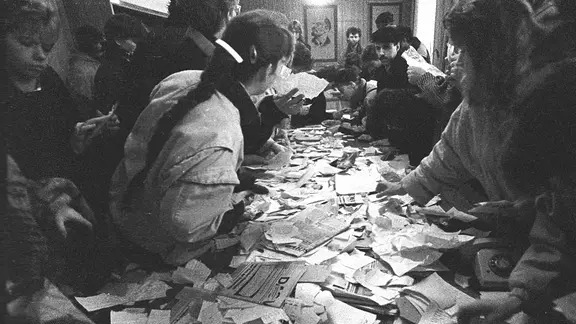
It never got that far. Citizens occupied Stasi offices across the country from early December 1989, and on 15 January 1990 they entered the headquarters in Berlin, securing millions of files and the sacks of torn paper (The Local).
One detail matters for the rest of this story. Some sacks held machine-shredded strips, cut so finely that nothing could be done with them. After review, that material was destroyed in 1991. Everything being reconstructed today was torn by hand (Federal Archives).
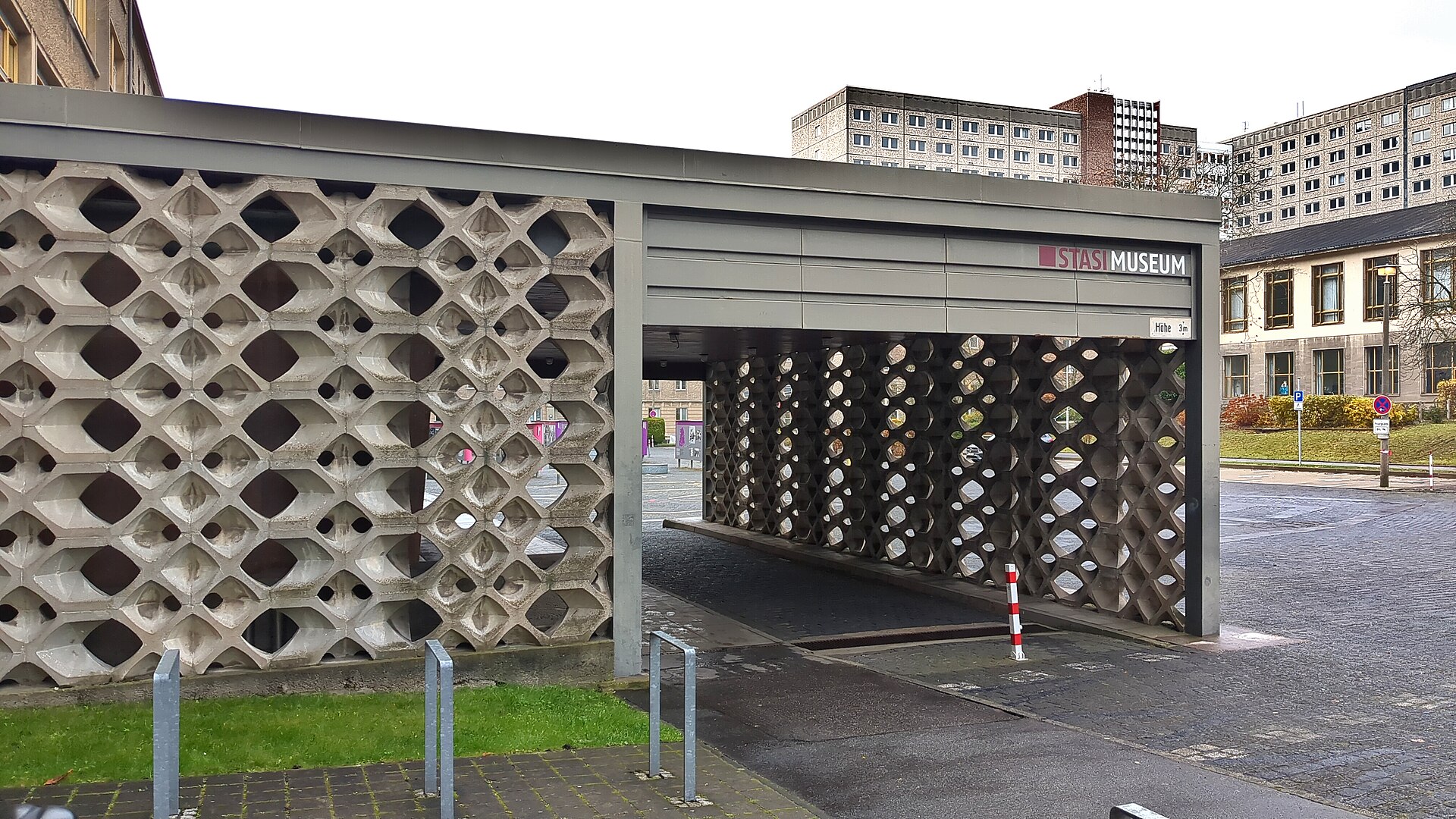
Former Stasi headquarters buildings in Berlin-Lichtenberg.
The puzzle by hand: 1995 to today
Manual reconstruction began on 24 February 1995 in Zirndorf, near Nuremberg, with more than 40 staff (Abendzeitung). The method has barely changed. The scraps are laid out like a jigsaw, matched, glued, and the restored pages are then catalogued and filed.
Not every sack is worth the effort. The archive picks sacks mainly by how badly the paper is torn: pages ripped once or twice are realistic to rebuild by hand. After that, it gives priority to units that spied on and persecuted people, to departments whose intact files are missing, and to regional history, since over half the torn material came from regional offices (Federal Archives).
The pace tells you why people hoped for a machine. By 2008, about 400 sacks had been completed, roughly 900,000 pages or 3% of the total. An average sack held about 3,000 pages torn into 12 to 15 pieces, and about one sack in five could not be done by hand at all because the pieces were too small (The Local, 2008). Fraunhofer estimated that 30 people would need 600 to 800 years to finish the job manually (Fraunhofer magazine).
Slow as it is, the manual work has paid off. Rebuilt files have documented the surveillance of dissidents such as Jürgen Fuchs, Robert Havemann and the writer Stefan Heym. They have exposed informants, shed light on state-sponsored doping in East German sport, and revealed files on Silke Maier-Witt, a Red Army Faction member who hid in East Germany (Federal Archives). For many people, a rebuilt page is the only proof of what happened to them
Paper sacks filled with hand-torn Stasi files in a German archive store.
Why the computer project stalled
This is where the story turns, and it is the part most articles leave out.
The e-Puzzler never became fast or reliable enough for the whole collection. The Federal Archives says the pilot never reached its target of reconstructing at least 80% automatically, and the process did not prove suitable for mass use at a reasonable cost. Scanning stopped in 2014 and puzzling in 2016 (Federal Archives). Regional Stasi commissioners had already complained that the scanner was too slow (Saxony commissioners' statement).
Some pages were simply hard for software. Handwritten sheets that had been folded before tearing produced scraps with almost identical outlines, which confused the matching (Techdirt, summarising The Guardian).
The ending was messy. Germany's procurement office terminated the contract in January 2023, and a legal dispute followed. On 15 May 2024 it was settled in a Cologne court: Germany agreed to pay Fraunhofer €470,000, against an original claim of €1.23 million. Since 2007, about €6.5 million had been paid for the project, and the computer had rebuilt roughly 91,000 pages from 23 sacks (Federal Archives).
What happens next
The story is not over. Since 2021, reconstruction has been a legal duty of the Federal Archives. Manual work carries on, and the archive is drawing up a new list of technical and quality requirements, followed by a market search for a provider that can do the job with today's technology (Federal Archives).
The archive also notes why other success stories do not transfer easily. Germany's central bank reassembles damaged banknotes, but every note follows the same printed template; Stasi files do not. Smaller projects, such as rebuilding parts of Leibniz's papers, involve far less material. Even the reconstruction system used after the 2009 collapse of Cologne's city archive was judged only partly comparable (Federal Archives).
Torn document reconstruction: five lessons for your own papers
You are probably not facing 600 million scraps. But the same principles apply to one torn birth certificate or a letter that came apart along its folds.
Keep every piece, however small. The Stasi team still finds missing pieces years later. Store fragments flat in a labelled paper envelope, not loose in a box.
Don't reach for household tape. Conservators generally advise against ordinary sticky tape on valuable paper because it can yellow and stain over time. Repair the scan instead, and leave the original as it is.
Scan both sides, with a margin. The e-Puzzler scanned both faces of every scrap. Do the same at 300–600 DPI on a plain, contrasting background so the torn edge is crisp.
Edges and content both matter. Software matched scraps by outline and by the lines and letters on them. A scan that cuts off the edge throws away half the evidence.
Know the difference between reassembling and filling. Putting real pieces back together recovers what exists. Filling a missing corner is a reconstruction. Both are useful, but a filled area should be marked as such in anything official.
Where Recovoly fits, and where it doesn't
We built Recovoly for the single damaged page, not for a national archive's sacks of scraps. That is a deliberate choice, and the Stasi project shows why it matters to be clear about it.
For a torn document you have scanned, Recovoly's Torn Repair tool lines up a handful of pieces and closes the tear, rebuilding paper texture and border lines across the gap. Where a corner is gone entirely, Fix Missing Corners and Rebuild Lost Parts reconstruct the paper from the surrounding page. Signatures, seals and handwriting outside the repair area are left exactly as scanned, and your original file is never changed.
What it will not do is guess at words that are completely missing and present them as fact. If text is gone, we would rather show a clean, honest gap than invent a sentence.
If you have a torn page to try, you can upload it free and compare the result side by side before you decide anything. For step-by-step advice, see our guide on how to restore a torn document.
Frequently asked questions
Can shredded paper be reconstructed?
Why couldn't computers finish the Stasi puzzle?
How long would the Stasi files take to rebuild by hand?
Can I repair a torn document myself without damaging it?
Is a digitally repaired document still authentic?
Related restoration tools

Written by
Thisara Jaso
Document Specialist
A document restoration specialist and historical document researcher passionate about preserving, restoring, and uncovering the stories behind historical manuscripts and archival records.


