

In this article
- The Archimedes Palimpsest at a glance
- What is a palimpsest?
- Copied in Constantinople
- Scraped and reused in 1229
- Found again in 1906
- Lost, painted and sold
- What was hidden underneath
- Why it was so hard: five layers on one page
- Step 1: Conservation came first
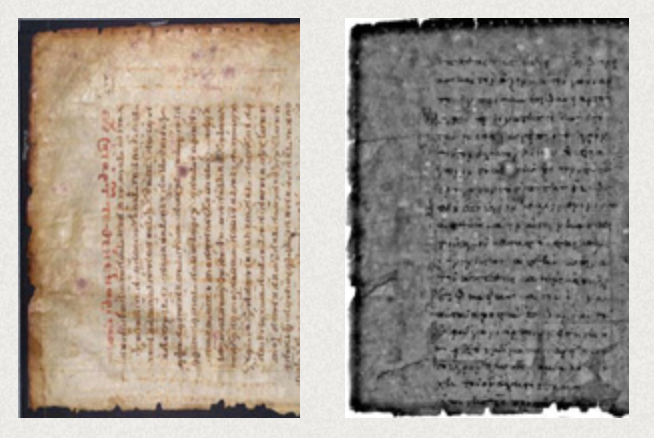
- Step 2: Multispectral imaging to recover erased text
- Why ultraviolet worked and infrared didn't
- The first try: make the prayers disappear
- The fix: keep both layers, in different colours
- Twelve bands of light, and new maths
- Step 3: X-rays for the painted pages
- An idea from a spinach lab
- From New Jersey to Stanford
- Step 4: Give the data away
- Five lessons for anyone trying to recover erased text
- Can you recover erased text from your own scans?
- Everyday palimpsests, and how Recovoly handles them
- Where any software has to stop
- Further reading
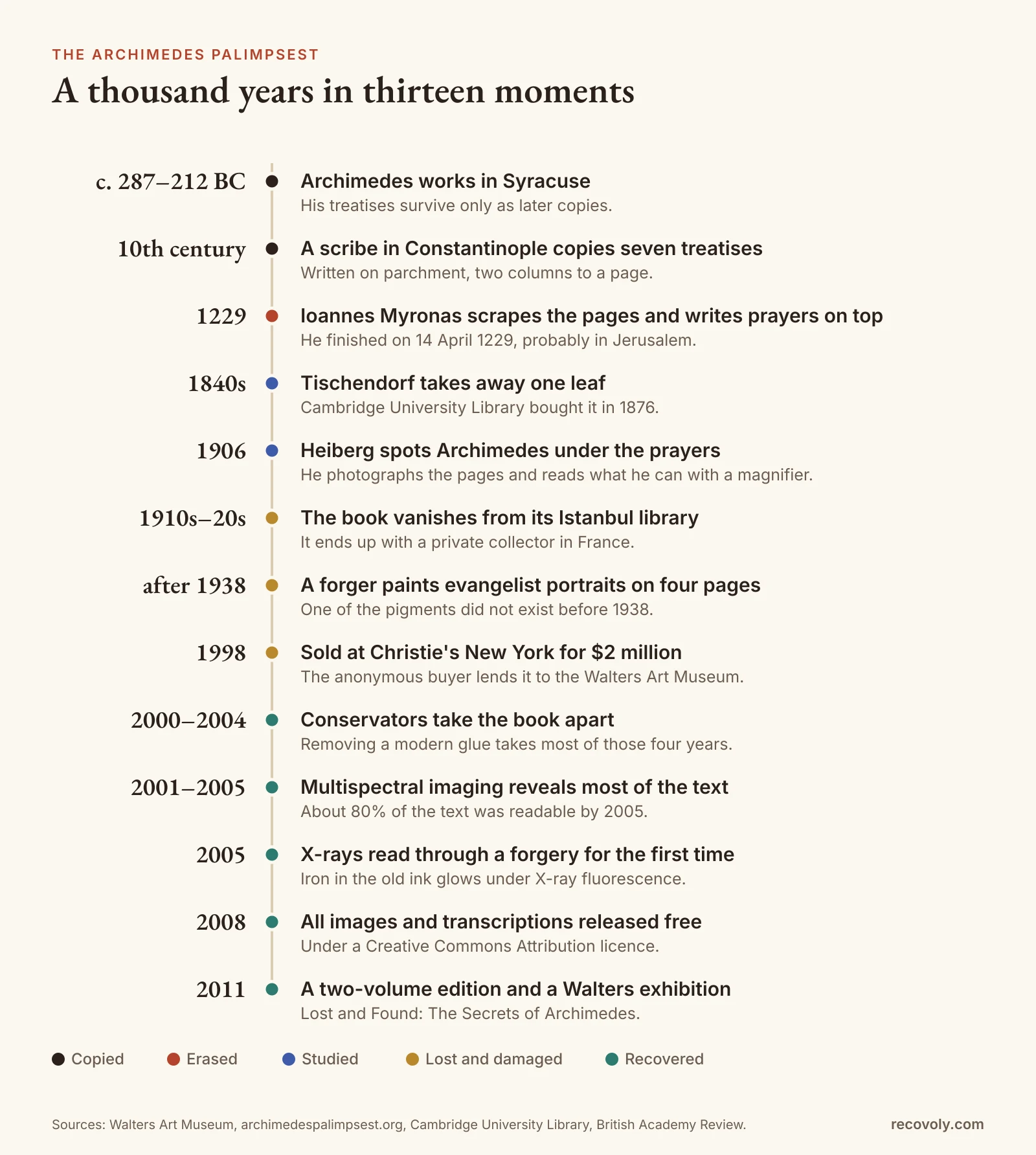
In October 1998, a stained, mouldy prayer book sold at Christie's in New York for $2 million. Nobody paid that much for the prayers. The buyer wanted what lay underneath: the oldest surviving copy of Archimedes, scraped off the pages almost 800 years earlier.
Over the next decade, a team at the Walters Art Museum in Baltimore set out to read it. Their task was to recover erased text that a scribe had removed on purpose. They used ultraviolet lamps, a dozen bands of light and, in the end, a particle accelerator. The museum's curator, William Noel, called the book "the ugliest thing in the collection" (NPR). Even so, it's the best case study we know for anyone who wants to recover erased text. It's also a useful guide to cleaning a marked page without harming what's underneath.
The main lesson is simple. Good restoration separates layers. It doesn't invent them.
The Archimedes Palimpsest at a glance
What | Detail |
|---|---|
Original copy | Seven treatises by Archimedes, copied in Constantinople in the mid to late 10th century |
Erased | By 14 April 1229, to make a Greek prayer book |
Other hidden texts | Two lost speeches by Hyperides and part of an early commentary on Aristotle |
Rediscovered | 1906, by the Danish scholar Johan Ludvig Heiberg |
Sold | October 1998, Christie's New York, $2 million |
Project | Walters Art Museum, from 1999, with more than 80 scientists and scholars over 12 years |
Recovered by multispectral imaging | About 80% of the text by 2005 |
Open data | About 4,000 images in 12 bands of light and 400 pages of transcriptions, under CC BY 3.0 |
Sources: Walters Art Museum, 2005, Walters Art Museum, 2011, Cambridge Digital Library, TEI project record.
What is a palimpsest?
Parchment is animal skin, scraped thin and dried. It took time and money to make. So when a book fell out of use, scribes often washed or scraped its pages and wrote on them again. We call the result a palimpsest, from a Greek word meaning "scraped again".
Scraping rarely removed everything, though. The Archimedes scribe had used iron-gall ink, made from crushed oak galls and iron sulphate (Stanford Magazine). Traces of that iron stayed in the parchment. Over the centuries, they showed up as faint reddish marks under the newer writing (Easton, Christens-Barry and Knox). The challenge is to read those marks without being swamped by the darker text on top.
Copied in Constantinople
Archimedes lived in Syracuse, Sicily, from about 287 to 212 BC. None of his own manuscripts survive. What we have are copies of copies. In the mid to late 10th century, a scribe in Constantinople copied seven of his treatises onto parchment. He wrote them in two columns per page (Cambridge; British Academy).
Scraped and reused in 1229
About 250 years later, a scribe named Ioannes Myronas needed parchment for a prayer book. He took the Archimedes book apart and scraped off the text. Then he cut each sheet down the middle, turned it 90 degrees and folded it again (project site). As a result, the old lines now run at right angles to the prayers. Part of every old page also vanished into the new spine. Myronas finished on 14 April 1229, probably in Jerusalem (Walters, 2011). He recycled pages from several other books too.
Found again in 1906
In 1899, a scholar cataloguing a church library in Istanbul noted maths under a 13th-century prayer book (British Academy). When the Danish scholar Johan Ludvig Heiberg saw a sample, he recognised Archimedes. He went to see the book in 1906, photographed the pages and read them with a magnifying glass (NOVA). His find made the front page of The New York Times (Archaeology).
Heiberg published the texts between 1910 and 1915. Still, he missed some passages and couldn't see the writing hidden in the binding (Exploratorium). One leaf had left long before. The biblical scholar Constantin von Tischendorf probably took it in the 1840s. Cambridge University Library bought it from his estate in 1876 (Cambridge).
Lost, painted and sold
In the 1910s or 1920s, the book vanished from the library (British Academy). It spent most of the century with a family in France. Some time after 1938, a forger painted gold portraits of the four evangelists over four pages. The aim was most likely to make the book look more valuable (NOVA). The portraits copy a medieval manuscript published in 1929. One of the pigments didn't exist before 1938 (Physics World; Nigel Wilson).
When the book came up for sale in 1998, the Greek Orthodox Patriarchate of Jerusalem sued to stop it. A federal judge in New York ruled for Christie's, so the auction went ahead (History of Information). An anonymous American collector won it. He then lent it to the Walters and paid for the research (Stanford Magazine).
By then the book was a wreck. Noel described burned pages, drips of candle wax, and purple stains and holes left by aggressive mould (Archaeology).
What was hidden underneath
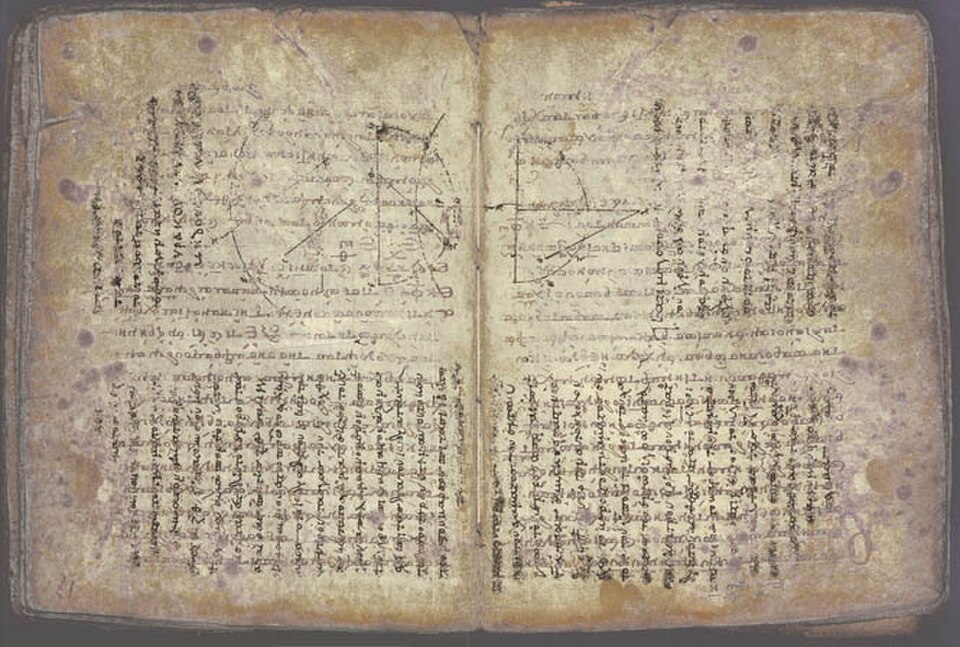
The Archimedes layer holds seven treatises (TEI project record):
The Method of Mechanical Theorems (the only known copy)
Stomachion (the only known copy)
On Floating Bodies (the only copy in Greek)
On the Equilibrium of Planes
On Spiral Lines
Measurement of a Circle
On the Sphere and Cylinder
In The Method, Archimedes explains how he found his results by "weighing" shapes against each other. It also shows him working directly with the concept of infinity (Walters, 2011).
Stomachion looked like notes on a children's puzzle, in which 14 pieces form a square. Reviel Netz of Stanford argued that Archimedes was really asking how many ways the pieces fit together. In 2003, a team of four mathematicians counted them: 17,152 (project site). If Netz is right, this is the earliest known Western work on combinatorics, the maths of counting arrangements.
The book held more than Archimedes, too. In 2002, Natalie Tchernetska of Cambridge spotted parts of two lost speeches by the Athenian politician Hyperides. They are Against Diondas and Against Timandros (Easterling). Then, in 2007, the team announced part of an early commentary on Aristotle's Categories. Scholars first linked it to Alexander of Aphrodisias, but the author is still debated (project site).
Why it was so hard: five layers on one page
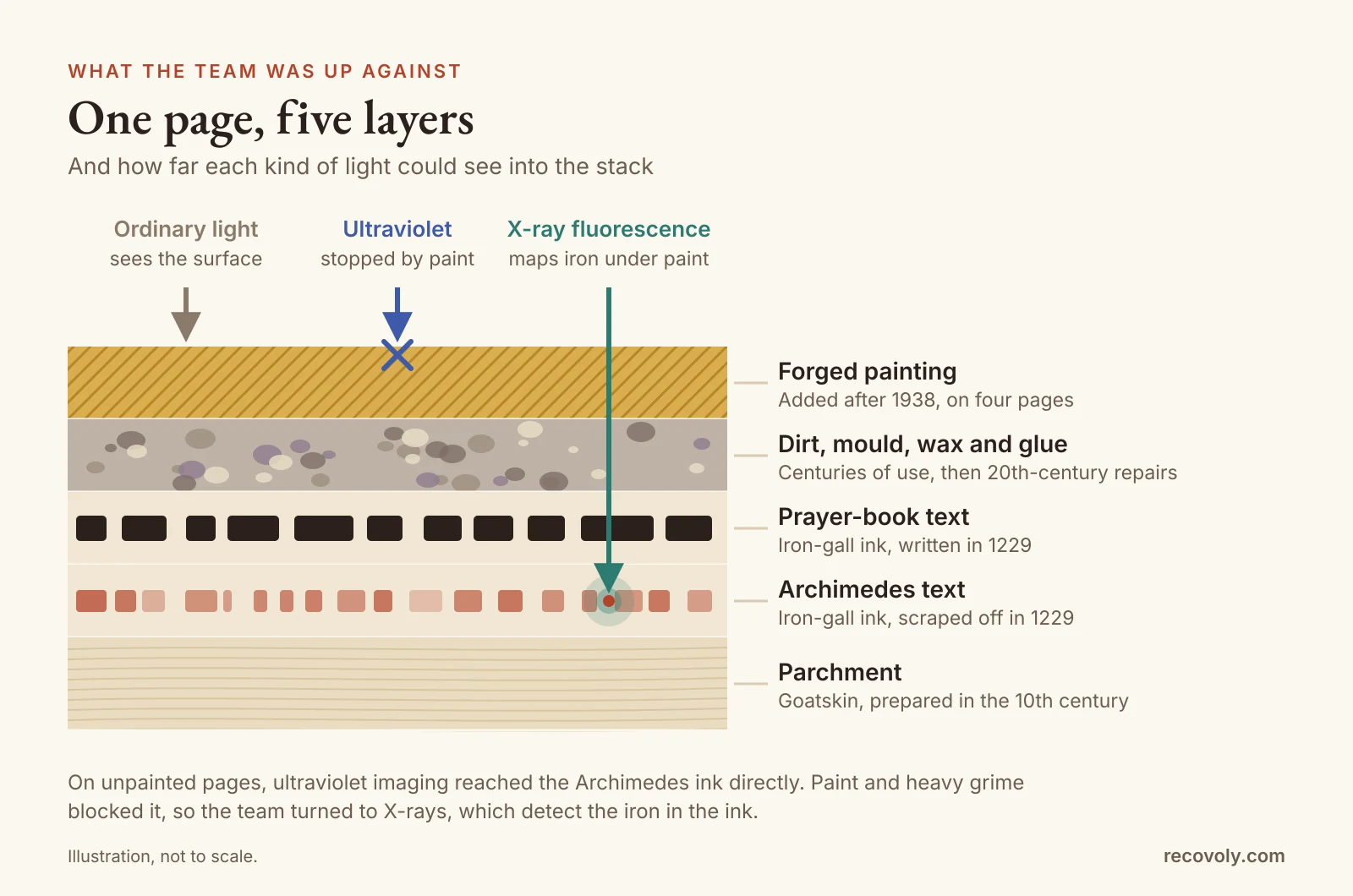
Think of each page as a stack. At the bottom sits the parchment. On it lies the faint Archimedes ink. Above that come the prayers, then centuries of dirt, wax and mould, plus a modern glue along the spine. On four pages, a forged painting covers everything. Because every layer behaved differently, the team had to tackle them one at a time.
Step 1: Conservation came first
You can't image a page you can't open. So the first job fell to Abigail Quandt, the Walters' senior conservator of manuscripts and rare books. She began taking the book apart in February 2000 and finished in November 2004 (project site).
The worst problem was a modern glue on the spine, similar to wood glue. It was stronger than the parchment it held. Quandt removed it slowly with a mix of isopropanol and water (British Academy). She drew a map of each leaf, marking mould, wax, glue and even modern Blu Tack. Then she lifted the candle wax by hand. She also logged and kept every scrap she removed (project site).
Imaging didn't wait for her to finish. From December 2001, she handed over 15 sheets every six months (British Academy). It's an easy point to forget in a digital world: you cannot restore what you cannot capture.
Step 2: Multispectral imaging to recover erased text
Three people led the imaging (project site). Roger Easton came from the Rochester Institute of Technology, Keith Knox from Boeing, and William Christens-Barry from Equipoise Imaging. Their tool was multispectral imaging. They photographed each page under narrow bands of light, from ultraviolet to infrared. Then they combined the results in software.
Why ultraviolet worked and infrared didn't
Infrared light is good at showing carbon-based ink. But the Archimedes ink held very little carbon. Instead, it held iron, and iron absorbs ultraviolet light (project site). Meanwhile, parchment glows blue under ultraviolet. So under a UV lamp, even faint iron ink shows up dark on a glowing page (Knox and Easton).
The first try: make the prayers disappear
At first the team tried to hide the prayer text completely. One method subtracted one image from another. Another made the prayer ink look like bare parchment. The results looked clean. However, the scholars didn't like them. They couldn't tell if a gap in the Archimedes text was really blank. It might just mark a spot where the software removed a prayer letter, and whatever lay beneath it (Knox and Easton; project site).
There was a technical snag too. The camera lens bent each colour of light slightly differently, so each band came out at a slightly different size. When the team stacked the images, the letters didn't line up. Those errors made the old script even harder to read (project site).
The fix: keep both layers, in different colours
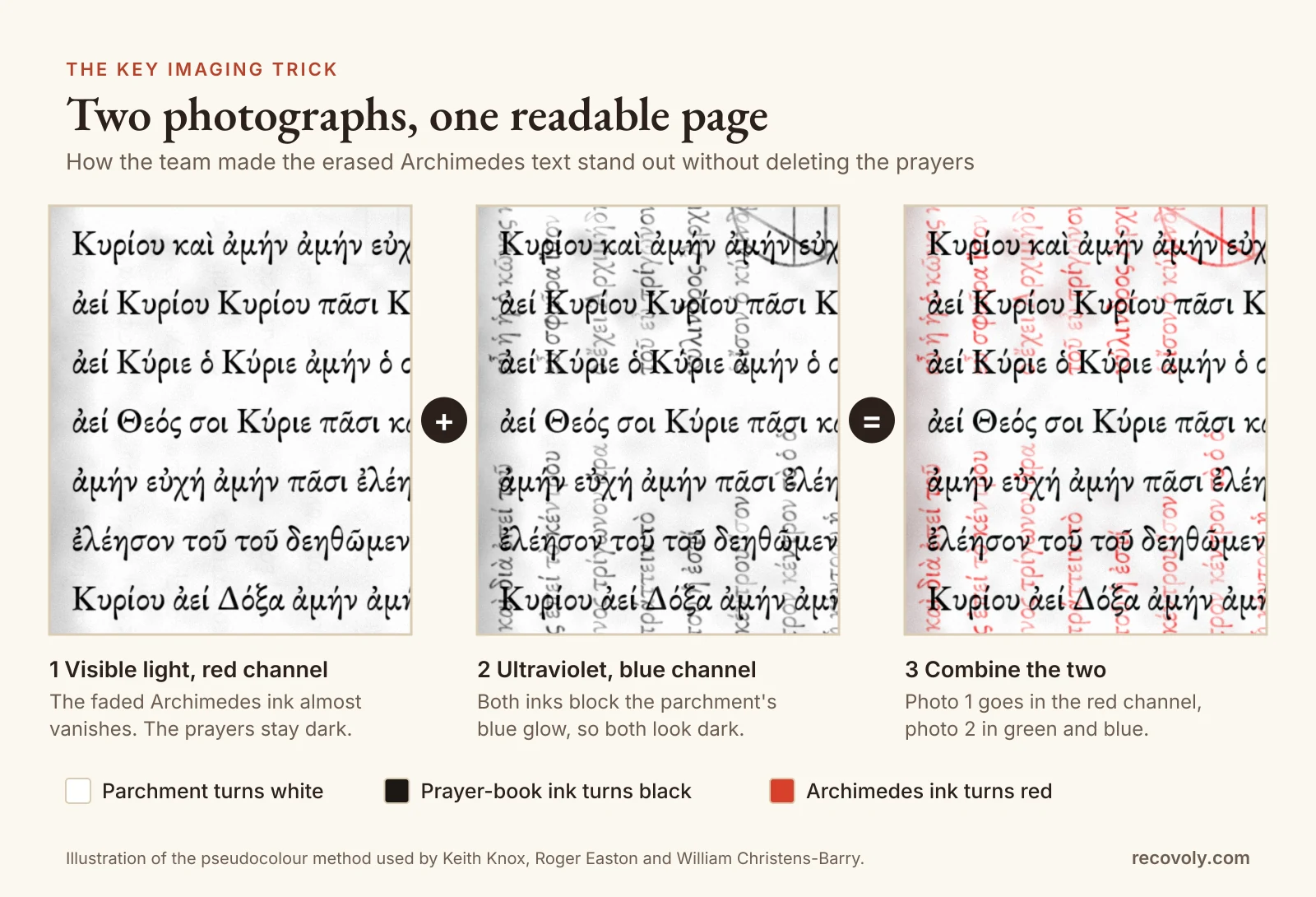
Keith Knox came up with a better answer, now known as pseudocolour (British Academy). It uses two photos of the same page:
A photo in ordinary light, red channel only. Here the reddish Archimedes ink almost vanishes, while the prayers stay dark.
A photo under ultraviolet light, blue channel only. Here both inks look dark against the glowing parchment.
Next, the red photo goes into the red channel of a new image. The ultraviolet photo fills the green and blue channels. As a result, the parchment turns white, the prayers turn black and the Archimedes text turns red (NPR; Bryn Mawr review).
Nothing gets deleted. The scholars could see both texts and decide for themselves where one hid the other. The prayers only got in the way of the diagrams, though. So for those, the team also made versions with the prayer text stripped out (project site).
Twelve bands of light, and new maths
By 2005, multispectral imaging had recovered about 80% of the text (Walters, 2005). In 2007, the team photographed the whole book again. This time they used 12 bands of light, plus raking light from the side. The bands ran from ultraviolet at 365 nanometres to infrared at 870 (History of Information).
Some pages still needed a different approach. For example, the Aristotle commentary barely improved with pseudocolour. In 2009, the team tried principal component analysis, a statistical method, on colour photos of the ultraviolet glow. Much of that text came through. The result changed how later projects photograph manuscripts (SPIE paper).
Step 3: X-rays for the painted pages
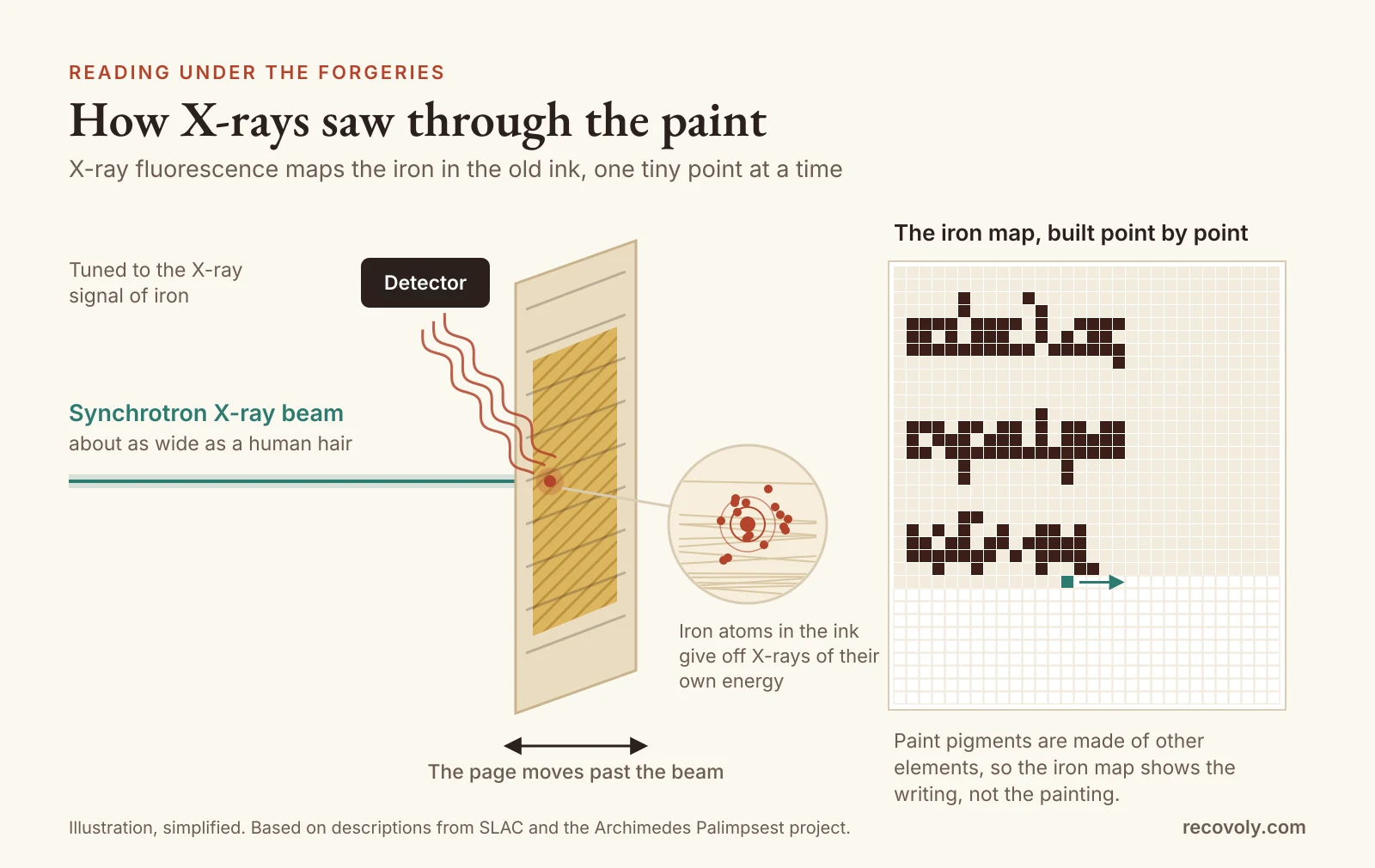
Light couldn't get through the forged paintings, and some pages were simply too dirty (British Academy). So in April 2004, the project held a small meeting about the last 20%. Three scientists separately suggested the same idea: X-ray fluorescence (project site).
The physics is neat. When X-rays hit an atom, it gives off X-rays of its own at an energy that identifies the element. Iron has one signature, calcium another, gold a third. So if you tune a detector to iron, you can map the old ink and ignore the paint on top.
An idea from a spinach lab
Uwe Bergmann, a physicist at Stanford's synchrotron lab, had the same thought on his own. In 2003, he was staying with his parents in Germany when he read a magazine article about the palimpsest. It mentioned iron in the ink (Stanford Magazine). At the time, he was using X-rays to study iron in spinach. His method could detect iron at about one part per million (NPR).
From New Jersey to Stanford
The first breakthrough came in April 2005. A commercial scanner at EDAX in New Jersey showed Archimedes text under a forged painting on folio 81r. A month later, pages went to Stanford (Walters, 2005). There, a beam about as wide as a human hair crossed each leaf point by point. Meanwhile, a detector built up the picture "like an old dot-matrix printer" (SLAC). In time, the team could image a full page in about 12 hours (Stanford Magazine).
Both inks contained iron, so the signal grew stronger where Archimedes letters sat under prayer letters. That let scholars trace the shapes of the old letters for the first time (project site). Later sessions also measured zinc and barium in the paint and scanned some pages from the back (SLAC Today). One scan even revealed the note where Myronas signed and dated his work (Walters, 2011).
Step 4: Give the data away
On 29 October 2008, ten years after the sale, the project put its core data online (project site). The release holds about 4,000 images in 12 bands. It also has 400 pages of transcriptions, mapped line by line onto the images (TEI). The data uses a Creative Commons Attribution licence. So anyone can reuse it, even commercially, as long as they credit the source (data set read-me). The raw images came to roughly a terabyte and went out to researchers on hard drives (Digital Classicist wiki).
In 2011, Cambridge University Press published the full edition in two volumes. Its editors were Reviel Netz, William Noel, Natalie Tchernetska and Nigel Wilson. That autumn, the Walters opened an exhibition, Lost and Found: The Secrets of Archimedes. It ran from 16 October 2011 to 1 January 2012 (Walters).
Five lessons for anyone trying to recover erased text
Name the layers before you pick a tool. The team faced scraped ink, overwriting, grime, glue and forged paint, and each needed its own method. A stamped, stained, faded office page is the same problem on a smaller scale.
Separate, don't delete. The scholars rejected images that wiped out the prayers. Instead, they wanted both layers visible in different colours. The museum even left the forged paintings in place (British Academy).
Judge results by what you can read. A smooth, clean image is worthless if the letters underneath are wrong. Always zoom in and check the actual text.
Know when software has run out. Ordinary photos couldn't see under the paint. Likewise, if a mark left no trace in your scan, no filter will bring it back.
Keep the original next to the result. The project published raw images alongside processed ones. That's why other people can still check the work.
There's a twist worth remembering. Noel believes the prayer book is probably why Archimedes survived at all. "If he hadn't pulled these ancient texts together and he hadn't given them a sort of Christian disguise, they would have been destroyed another way," he told NPR.
Can you recover erased text from your own scans?
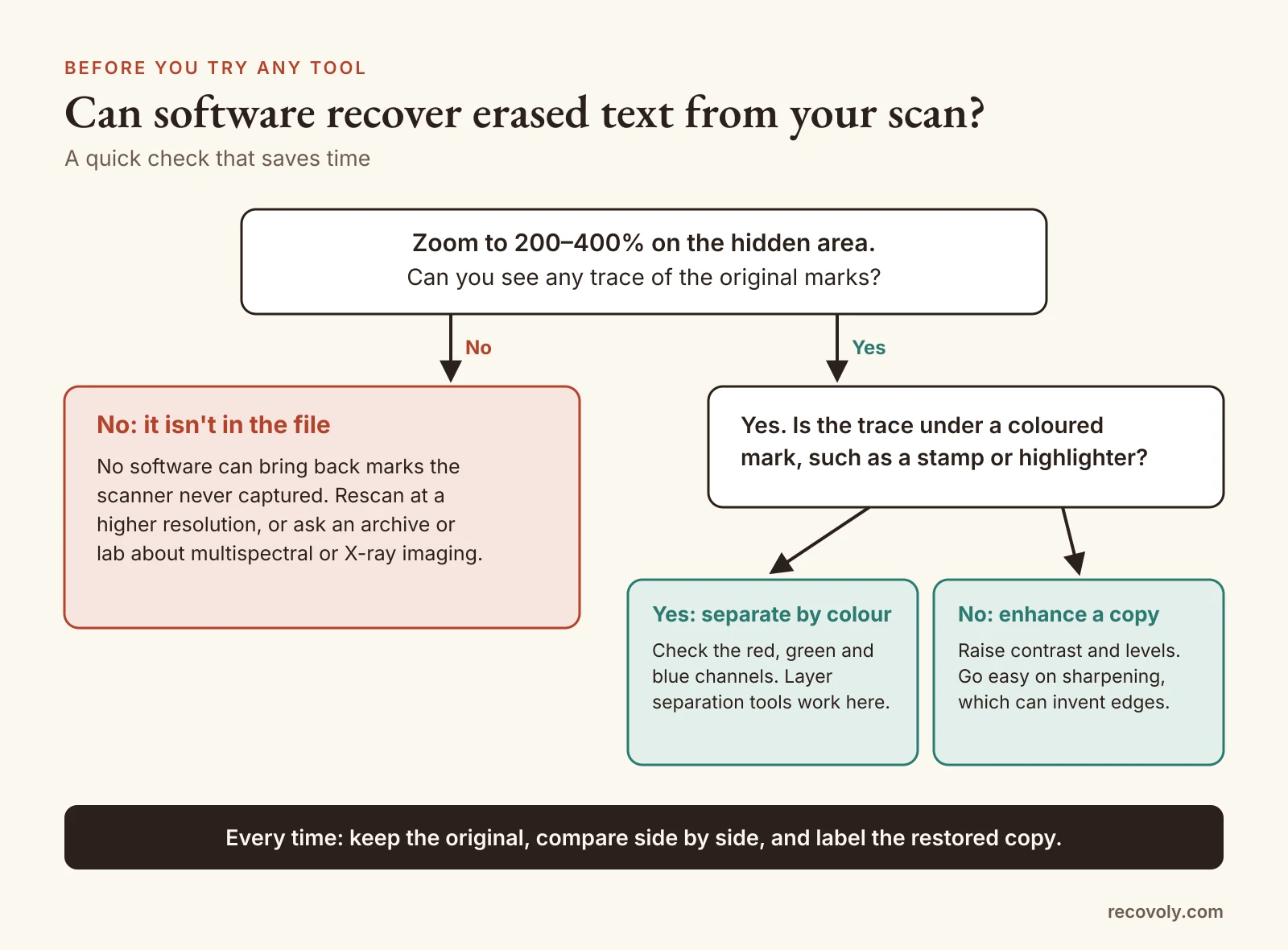
Most of us will never need a synchrotron. Still, the same logic works on an ordinary scan. Before you try to recover erased text from a file, ask one question. Is there any trace of the hidden marks in it?
Zoom in to 200 or 400%. If you can see faint strokes, there's something to work with. If the area is solid black, or the marks were scraped or bleached away before scanning, the information isn't there. Any software that "finds" it is guessing, and a guess is not recovery.
You can also try the Archimedes trick yourself. Open the scan in any photo editor and view the red, green and blue channels one at a time. A red stamp often fades almost to nothing in the red channel. That's because red ink reflects red light, much like white paper does. Similarly, blue ink tends to fade in the blue channel. Meanwhile, black text underneath usually stays dark in all three. It's a quick way to see what's truly hidden and what's only covered.
Everyday palimpsests, and how Recovoly handles them
Most documents we see have their own small palimpsest problems. Think of a rubber stamp over a typed line or a library mark across a title page. A wax seal on a signature or a highlighter stripe through a date works the same way. In each case the question is the same. How do you remove the top layer without damaging what's underneath?
Recovoly's Remove Stamps tool works on that principle. It identifies the stamp ink, separates it from the text beneath and repairs only the marked area. Handwriting, printed text and signatures outside the repair stay exactly as they were. Object Cleanup handles marks such as spots and seals, and Selective Restoration lets you choose precisely which area gets touched. We walked through a real example in our wax seal removal case study.
Where any software has to stop
We're also clear about the limits. Sometimes a mark completely covers part of a letter. Any tool that fills that gap is rebuilding the letter, not recovering it. So check those spots against your original. And if you need to recover erased text that never made it into your scan, no software can do it. A study at University College London tried to simulate multispectral images from ordinary digital photos. It worked on some of their own test images. However, it failed on the free Archimedes images, because the method needed the original camera setup (UCL).
Got a stamped or marked page? You can try Recovoly free and compare the result side by side with your original.
Further reading
Archimedes Palimpsest project site. Background on the story, the team and the scholarship.
Open data set. Every image and transcription, free to reuse with credit.
The Archimedes Codex by Reviel Netz and William Noel. The full story in book form.
NPR, "A Prayer Book's Secret: Archimedes Lies Beneath". The X-ray work, in the scientists' own words.
We checked every date and figure in this post against the sources linked above, mostly the project's own reports and the scientists' papers. The diagrams are our own illustrations. The Greek text in them is decorative, not a transcription.
Frequently asked questions
What is a palimpsest?
How much of the Archimedes text was recovered?
Can software recover erased pencil or scraped-off ink from my document?
Where can I see the Archimedes Palimpsest images?
Is it legal to remove a stamp from a scanned document?
Related restoration tools

Written by
Thisara Jaso
Document Specialist
A document restoration specialist and historical document researcher passionate about preserving, restoring, and uncovering the stories behind historical manuscripts and archival records.


